RELEVANT RESEARCH FOR PERFORMERS SERIES: No. 1
Are We Trombonists Playing Berlioz Correctly?
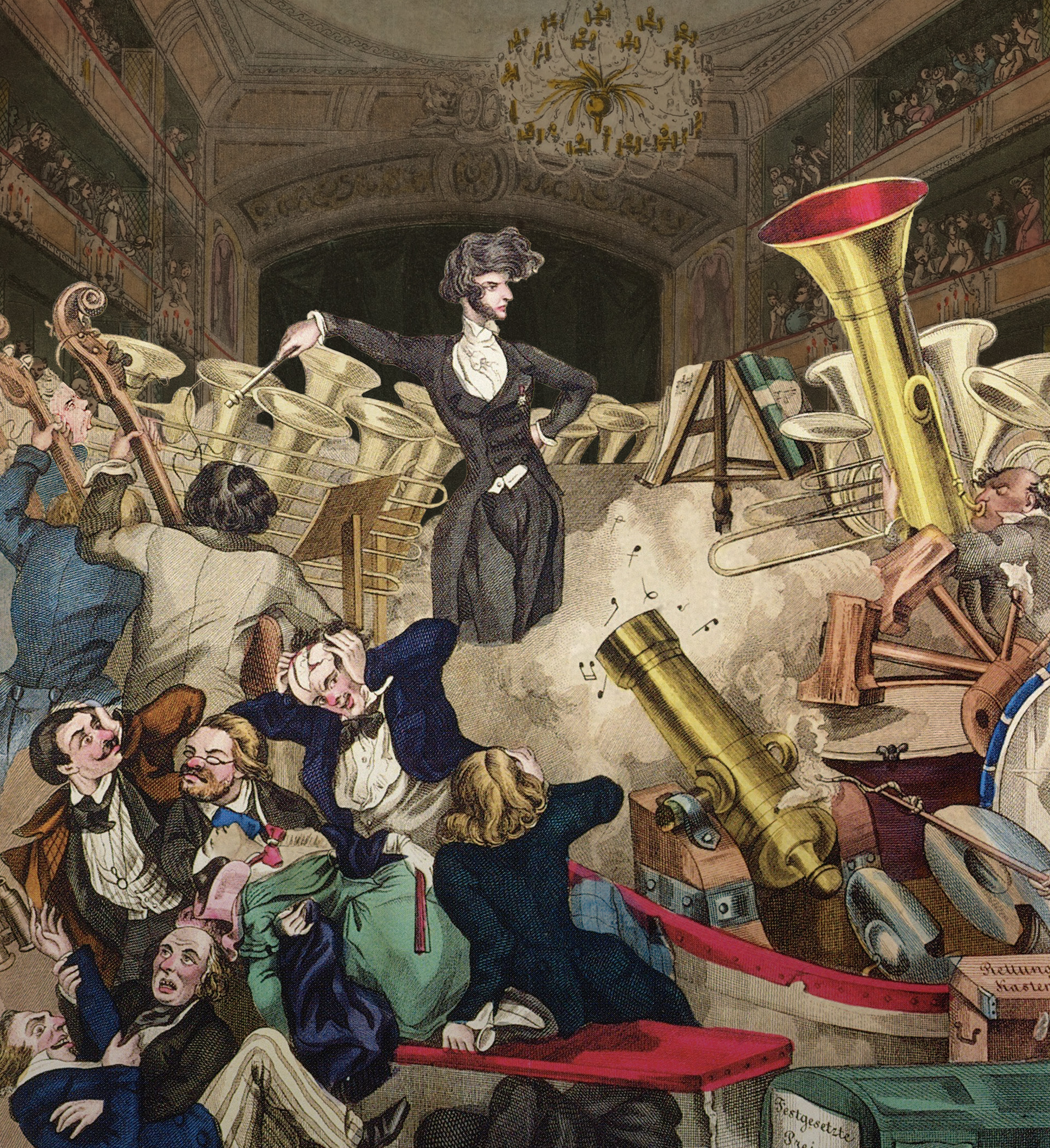
Caricature by artist J.J. Grandville, entitled “Berlioz conducting” published in “Wiener Theaterzeitung” in 1846.
Contrary to popular belief, Berlioz did not favour the sound of the alto trombone and did not wish to include it in the orchestral trombone section.
He wasn’t that keen on the bass trombone either.
by Ken Shifrin
(Extracted and developed from my PhD Dissertation, Orchestral Trombone Practice in the Nineteenth Century with Special Reference to the Alto Trombone, Oxford University, England, 1999. I am particularly indebted to Hugh MacDonald, General Editor of Hector Berlioz: New Edition of the Complete Works for his enormously helpful and friendly correspondence — Ken Shifrin.)
The purpose of this article is to examine the historical evidence in order to determine the correct make-up and sound of the Berlioz trombone section. Berlioz, more than most composers, revered and deliberated on the sound of the trombone section. Whether he preferred the light-timbered alto or the heavier, more robust tenor to lead the section is crucially relevant to performances today. Likewise, it is equally important to know how Berlioz felt about the bass trombone. As Berlioz himself says in his Grand Traité d’Instrumentation et d’Orchestration, performers should always use the instrument indicated by the composer and no other, that “to do otherwise is to take unpermitted latitude in the interpretation of the composer’s wishes [and] to open the door to all sorts of incorrectness and abuses.”1 If an inappropriate instrument is used instead of the intended instrument a sound quality is produced which is incompatible with an interpretation that is true to the performance of the work. One’s choice will influence the sound and style not only of the trombone group, but also that of the entire brass section which, with its powerful voice, can affect the colour of the orchestra.
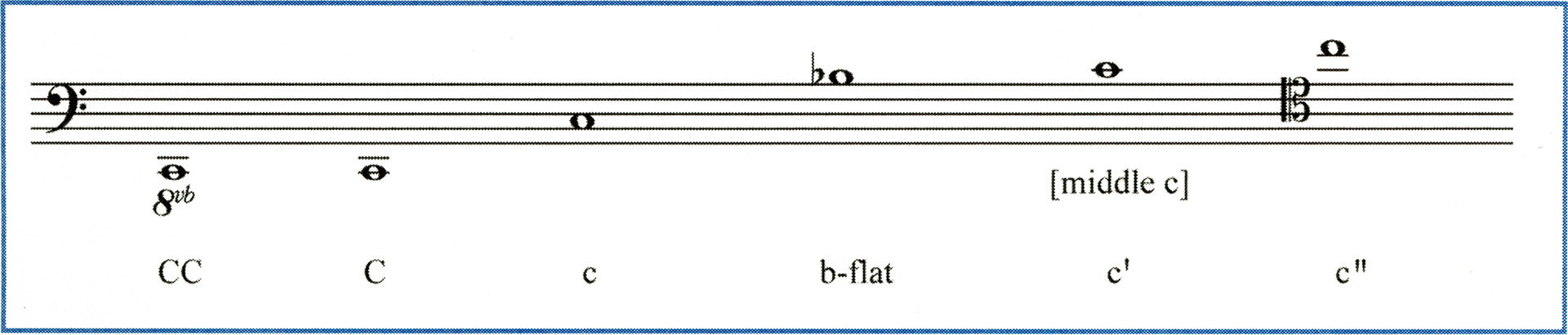
The following pitch designations are used throughout this article.
Alto or Tenor Trombone?
“The alto trombone part should not be played, as is often done in France on a big [tenor] trombone. I request a true alto trombone.”*
— Hector Berlioz, autograph score of Symphonie Fantastique, 1830
“It is to be regretted that at present, the alto trombone has been banished from all our Paris orchestras.”
— Hector Berlioz, Grand Traité d’Instrumentation et d’Orchestration, 1844
Over the years I have lost count of the number of times these quotes have been trotted out in trombone articles (including in the pages of the ITA Journal) and dissertations as “proof” that not only should the first trombone part to Berlioz’s Symphonie Fantastique and other of his works be performed on alto trombone (or at least a small-bore tenor to approximate an alto) but that Berlioz was enamoured with the sound of the alto trombone.
However, a closer examination of Berlioz’s comments about the alto trombone reveals a far different story. Although Berlioz states in 1842 in the Revue et Gazette Musicale de Paris3 that he despaired the absence of the alto trombone from the orchestra, a statement he repeats in Grand Traité of 1844, it is not on account of his fondness for its sound, which he describes in this Grand Traité as rather shrill (“grêle”4), with a low register that was of particularly poor quality (“d’un mauvais timbre”5) and best to be avoided. On the other hand, Berlioz unambiguously states that of all three species of trombone he preferred the tenor, “assuredly the best of all. It has a full and powerful sonority … and its tone is good throughout its entire range”6 which, based on his observations, extended to a b’♭ as its uppermost usable note.7 According to the Traité only tenor players of the greatest skill were capable of playing higher than b♭’ [high B♭] with d♭” [high D♭] being considered the absolute highest note possible.
Thus Berlioz’s despair over the absence of the alto trombone was due to the loss of the notes b’ – f”8 and, despite its unsatisfactory sound, advocated in his Grand Traité a place in the orchestra for the alto trombone basically as an upper-register aid.
Therefore, when we look at the tessitura of the first trombone part of his Symphonie Fantastique—in particular the “March to the Scaffold” (Example 1)—in light of what he considered possible on the tenor trombone, we can more clearly understand why Berlioz wrote on the autograph score next to the first trombone part “je demande un véritable alto” (Figures 1 and 2). As stated above, we see it was not for reasons of tone colour that Berlioz designated an alto trombone for the first part, but because he was under the impression that the upper register demands were beyond a tenor trombonist’s capability. Or to put it in modern day parlance: Although Berlioz thought the alto sounded like cr*p, he didn’t think a tenor trombonist had the chops to play the high licks.
Figure 1: Berlioz, Symphonis Fantastique, autograph score, page 1.
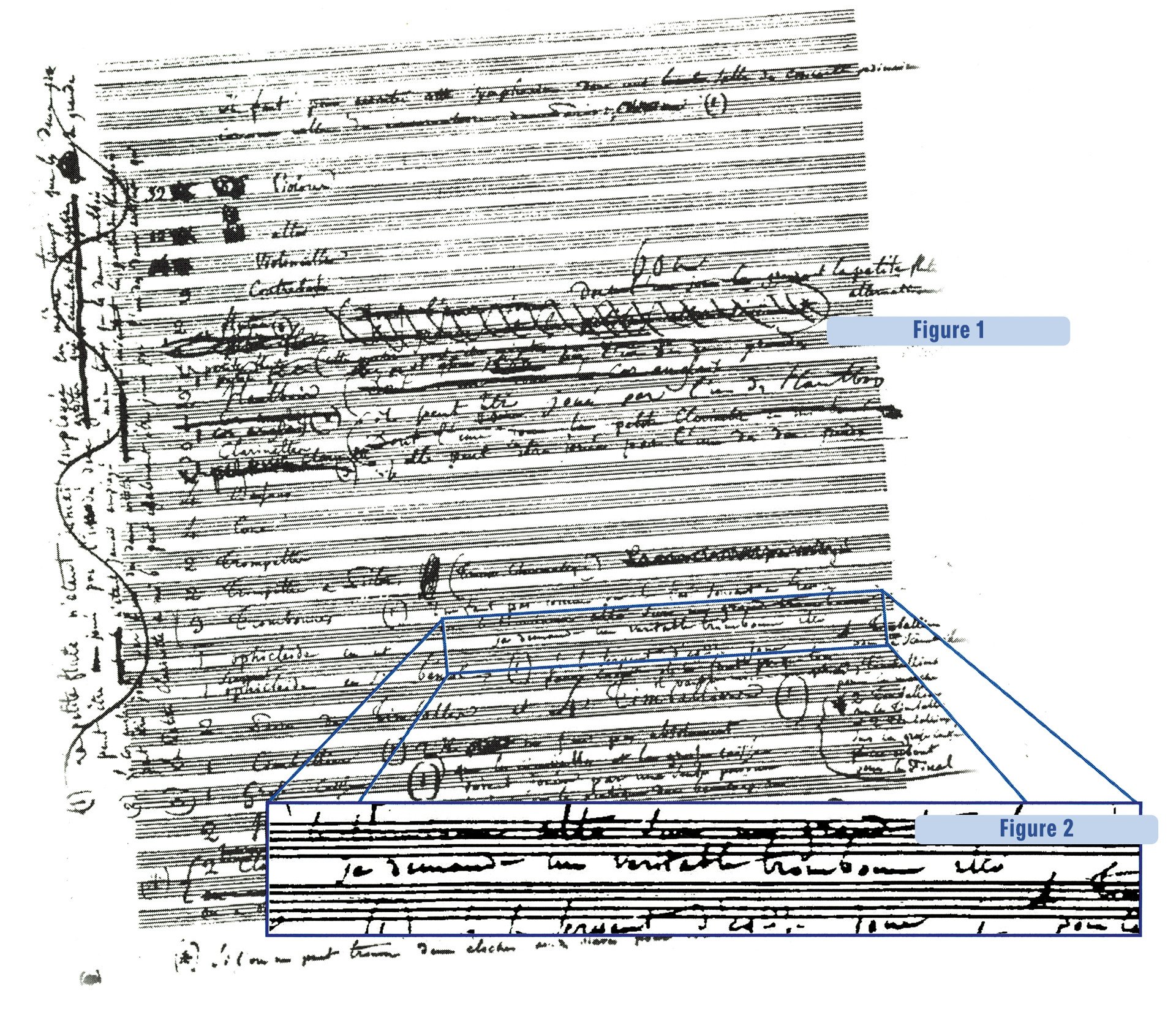
Figure 2: Berlioz, Symphonis Fantastique, autograph score, page 1, inset, shows an enlargement of instructions, “je demande un verritable trombone alto.”
Also, it should be noted that it seems that the virtuoso trombonist, Antoine Dieppo, “the greatest trombonist that ever lived”9 had not yet arrived in Paris—or at least Berlioz was apparently not yet familiar with him—when Symphonie Fantastique was first composed in 1830. Moreover, Berlioz revised the work extensively in subsequent years and did not publish it until 1845, by which time, as we shall see, his view on the upper register capability of the tenor trombone appears to have changed.
In a letter written on October 8, 1843, to Louise Bertin, singer/pianist and daughter of the editor of the Paris Journal des Débats, three months prior to publication of the Grand Traité and nearly a year after submitting the manuscript to the publisher,10 Berlioz expressed a less well-known opinion about the alto trombone which revealed a new perspective. Based on his conducting experiences in Berlin, he wrote:
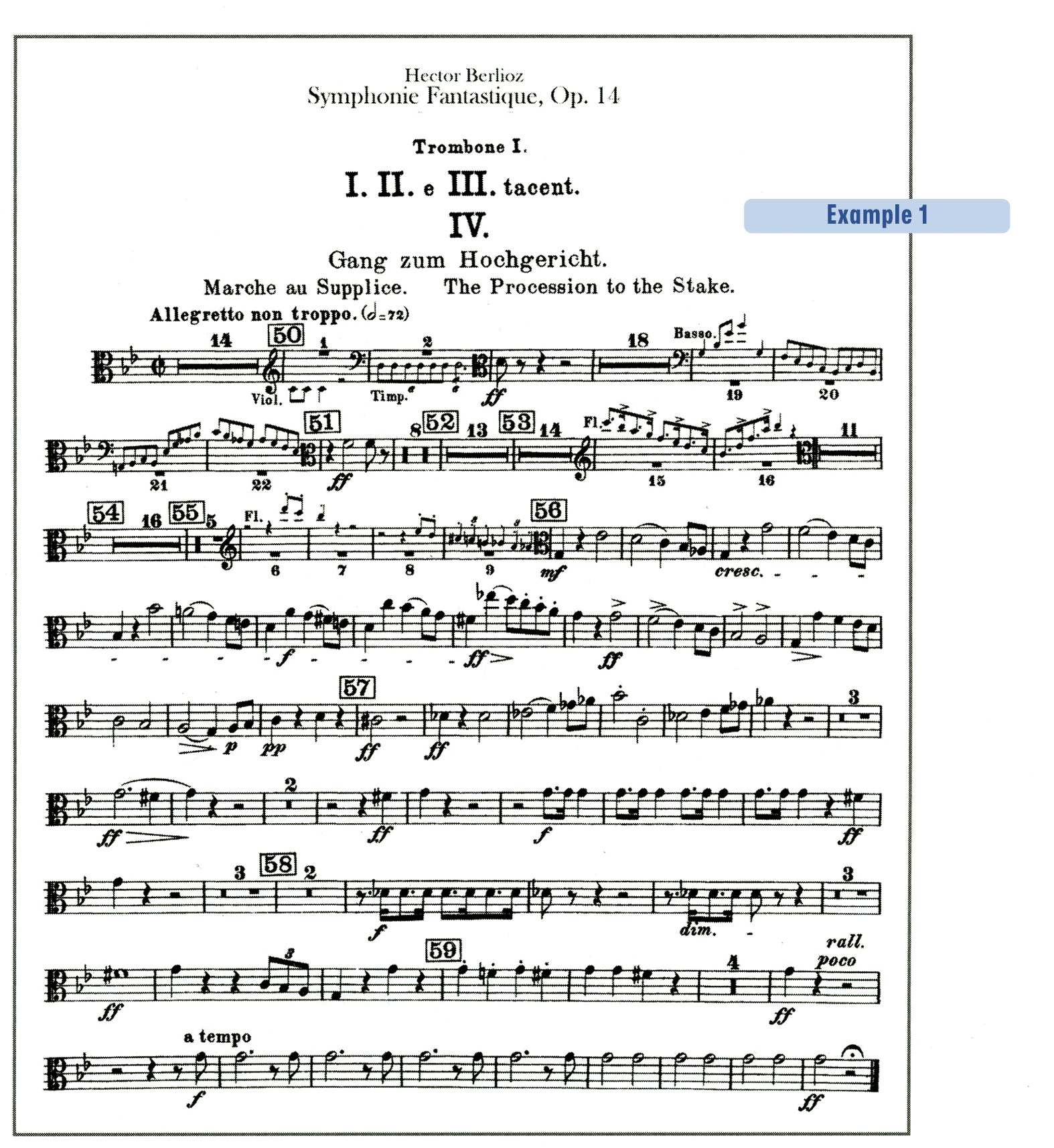
Example 1: Berlioz, “March to the Scaffold” from Symphonis Fantastique,
First Trombone. (Breitkopf & Haeltel, 1900).
“Having made repeated observations of the kind in Berlin, I now believe that the best solution in the opera house is after all the solution adopted at the Paris Opera, and that is to use three tenor trombones. The tone of the small alto trombone is shrill and its high notes are of little use. I would therefore vote to exclude it also from theatre orchestras.”11
It is clear from this letter that Berlioz no longer considered the alto indispensable with regard to the upper register and for reasons of sonority, balance, and section blend it would be best to replace the strident alto trombone with a tenor on the first part.
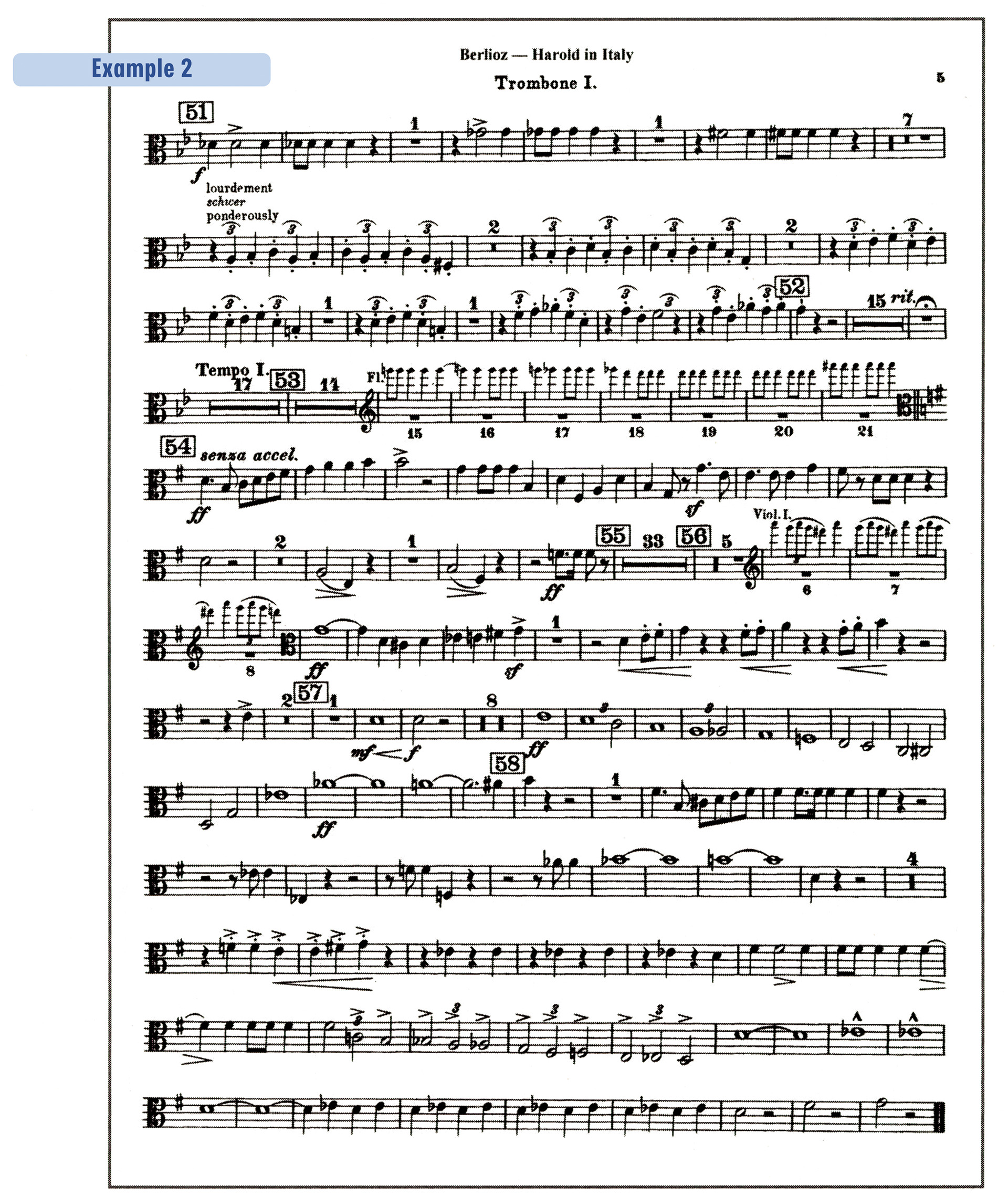
Berlioz, Harold in Italy, Movement IV “Orgie der Britanten”, First Trombone.
(Breitkopf & Haeltel, 1900).
Could it be that the more Berlioz travelled and conducted abroad he had become aware that tenor trombonists could be expected to play reliably above b’♭? One can speculate that he was influenced in coming to this conclusion by the highly favourable impression that the principal trombonist in Stuttgart, Schrade, had made on him in a concert he directed on December 29, 1842, shortly after he had submitted his manuscript of the Traité to the publisher. Berlioz enthusiastically praises Schrade who performed on tenor trombone, among other works, two of Berlioz’s most demanding compositions which he had heretofore thought only playable on an alto: the overture Les Francs-Juges (demanding four successive d♭”s) and “March to the Scaffold” from the Symphonie Fantastique (calling for an e♭”). Berlioz writes to the violinist/composer/conductor Narcisse Girard:
“The trombones are a fine section … The Principal Trombone (Mr Schrade) … is a talented player. He is a complete master of his instrument, capable of performing the most difficult passages and producing a magnificent tone on the tenor trombone.”¹12
With regard to the reference to “the opera house,” by around 1800 in Paris most public concerts were performed in theatres by theatre orchestras and trombone parts in French concert music were virtually the same as in the theatre; thus, what is applicable to one is applicable to the other. Moreover, whether a trombone section plays upon or below the stage, the concept of ensemble and blend are essentially the same.
According to Hugh MacDonald, General Editor of Hector Berlioz: New Edition of the Complete Works in a letter to this writer:
“Berlioz wrote for the alto trombone in his early music with the upper trombone part notated in the alto clef, at least through the composition of Harold en Italie (1834). This includes the Messe solennelle, Scène héroïque, La Mort d’Orphée, the overtures Les Francs-Juges, Waverley, and Roi Lear, Cléopâtre, and the 1832 version of Lélio.”13 14
With regard to Harold en Italie, the first trombone part is not particularly high by today’s standards, and often comes as a surprise to trombonists that Berlioz had originally thought it was only playable by an alto. (Example 2)
However, while he preferred the bigger and more powerful tenor trombone with its fuller sonority to the alto, it would be a mistake to conclude that Berlioz liked a lot of noise. In his Traité he writes:
“General prejudice charges large orchestras with being noisy. However, if they are well balanced, well rehearsed and well conducted, and if they perform truly good music, they should rather be called powerful. In fact, nothing is as different in meaning as these two expressions.”15
and he heaped abuse on the “herd of composers”16 who “vulgarized this noble and dignified instrument so capable of depicting human emotions”17 and the conductors who allowed the trombone’s majesty to degenerate into raucousness.
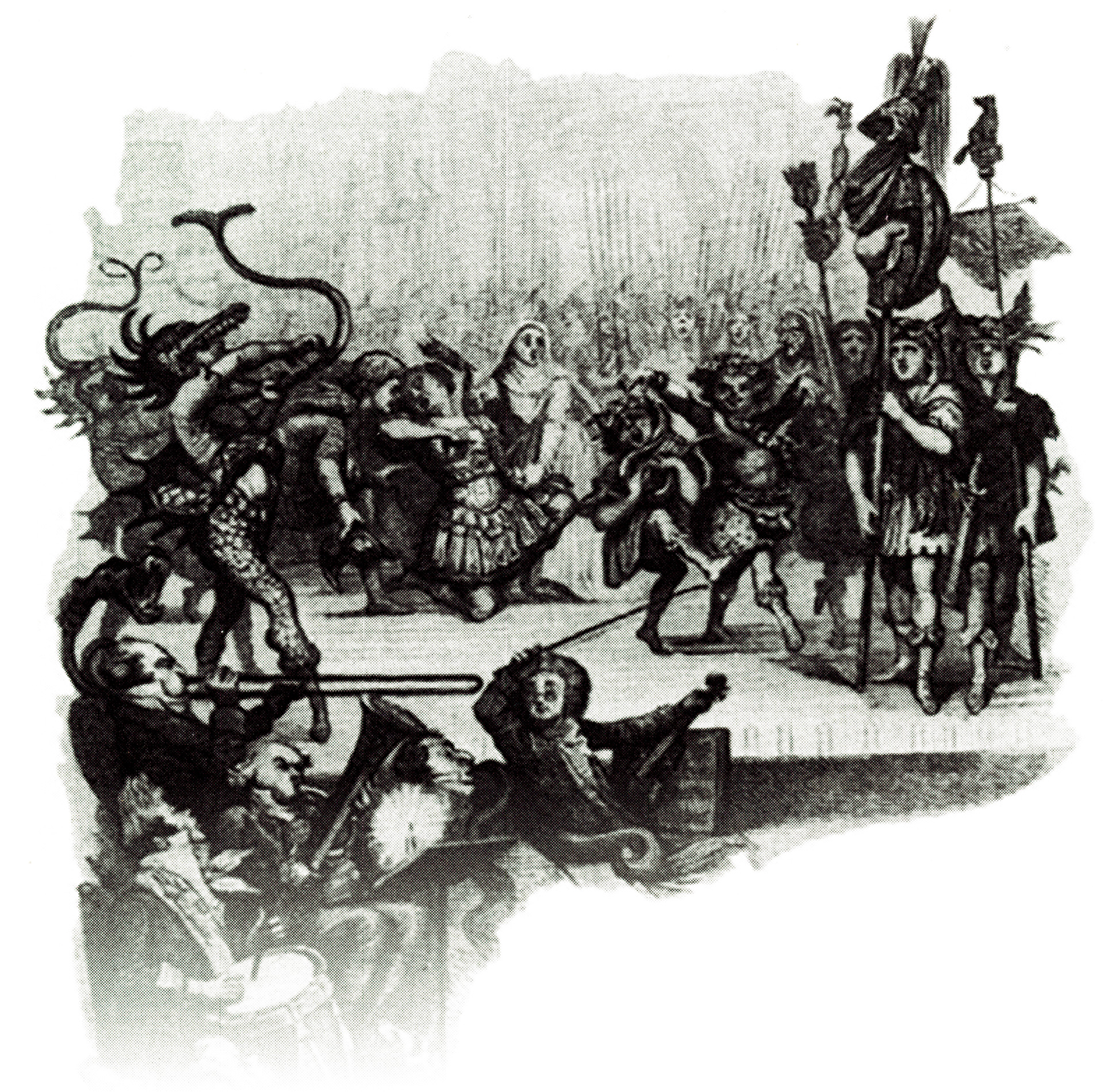
Figure 3: 1843, Caricaturist’s impression of Berlioz’s concert in Berlin. Note the trombonist standing, as instructed be Berlioz.
The Bass Trombone: He’s “Not About That Bass, ‘Bout That Bass, Just Tenor”
(with apologies to Meghan Trainor)
At the time of the writing of his Grande Traité, according to Berlioz the bass trombone, which he describes as pitched in E♭, had completely disappeared18 from Paris and been replaced by a tenor trombone. However, a few paragraphs later he amends this to say “the majority”19 of the Parisienne orchestras did not employ a bass trombone. In any case it appears that the only time Berlioz wrote for an E♭ bass trombone was the optional fourth trombone part in the Grande Symphonie Funèbre et Triomphale in 1840 (Example 3).20
Although in December 1842, when Berlioz submitted the manuscript of his Grande Traité, he bemoaned the fact that the low D and E♭ in Weber’s Freischütz were lost in Paris when the formerly E♭ bass trombone part was played on the tenor trombone, nonetheless he disliked the fact that in forte passages “the sound of the bass trombone always predominates more or less … over the other two trombones, especially if the first is an alto trombone.”21 Indeed, after his experience several months later with the Berlin Orchestra he concluded that—at least as far as his own works were concerned—for reasons of section sonority and balance it would be best to do away with the bass trombone and replace it with a tenor trombone.
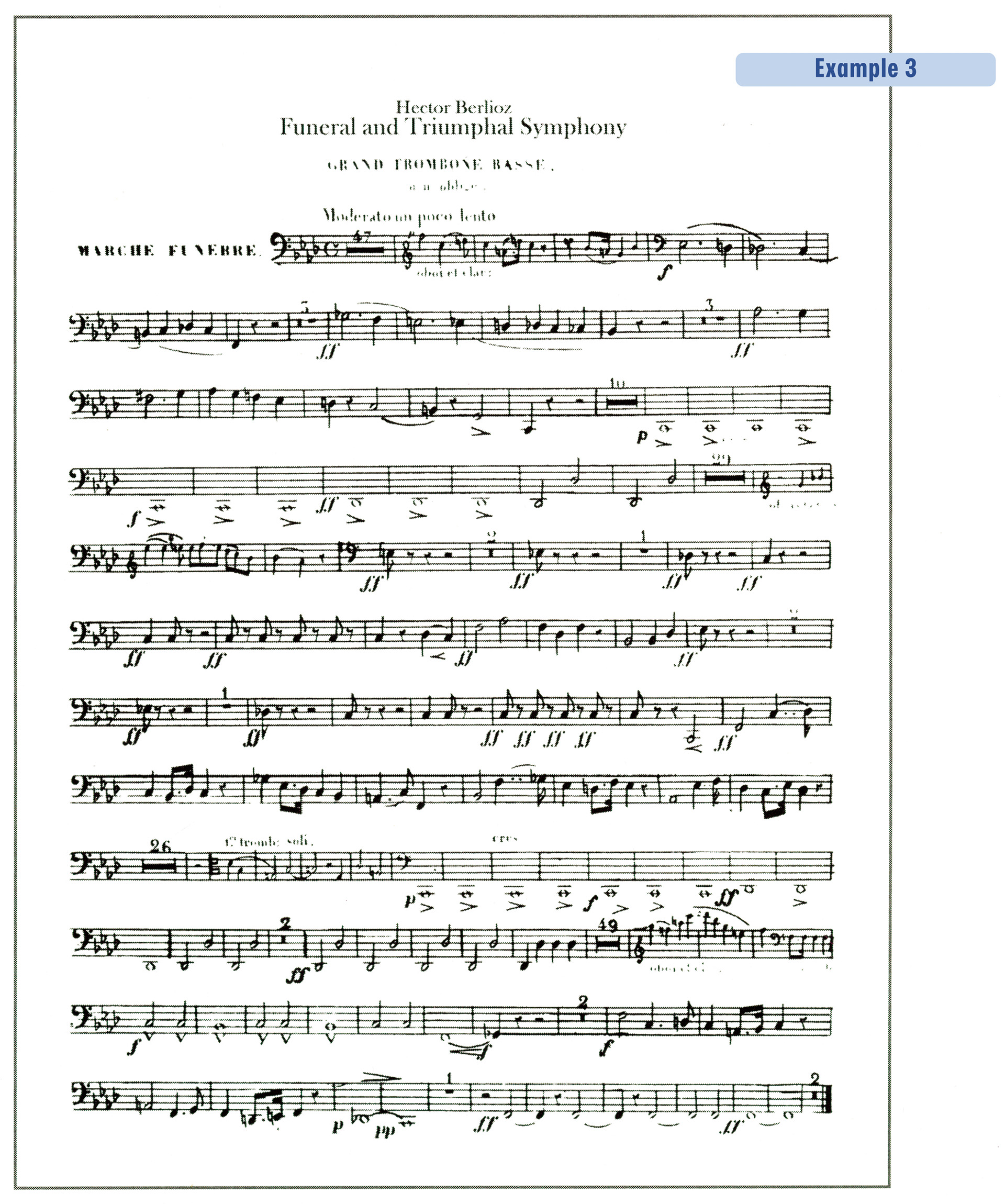
Example 3: Berlioz, “Marche Funebre” form Grand Sinfornie Funebre et Triophale, Bass Trombone (in EB). (IMSLP/Petrucci Music Library)
In the same letter of October 1843 to Mademoiselle Bertin in which he discussed his new perspective regarding the alto, Berlioz articulates his views on the bass trombone:
“Berlin is the only German town where I found the deep bass trombone (in E♭). We have none in Paris, the performers there declining the practice of an instrument which tires their chests. Apparently Prussian lungs are more robust than ours. … In my concerts … I was obliged to beg the artist who played it to sit so as to turn the bell of the instrument towards the desk, which thus served as a sort of sourdine, whilst the alto and tenor trombonists played standing, with their bells above the desk. In this way alone could the three parts be heard. … [I would] allow the presence of a bass trombone only if the music were in four parts and there were three tenors capable of holding their own against it.”22 (Figure 3)
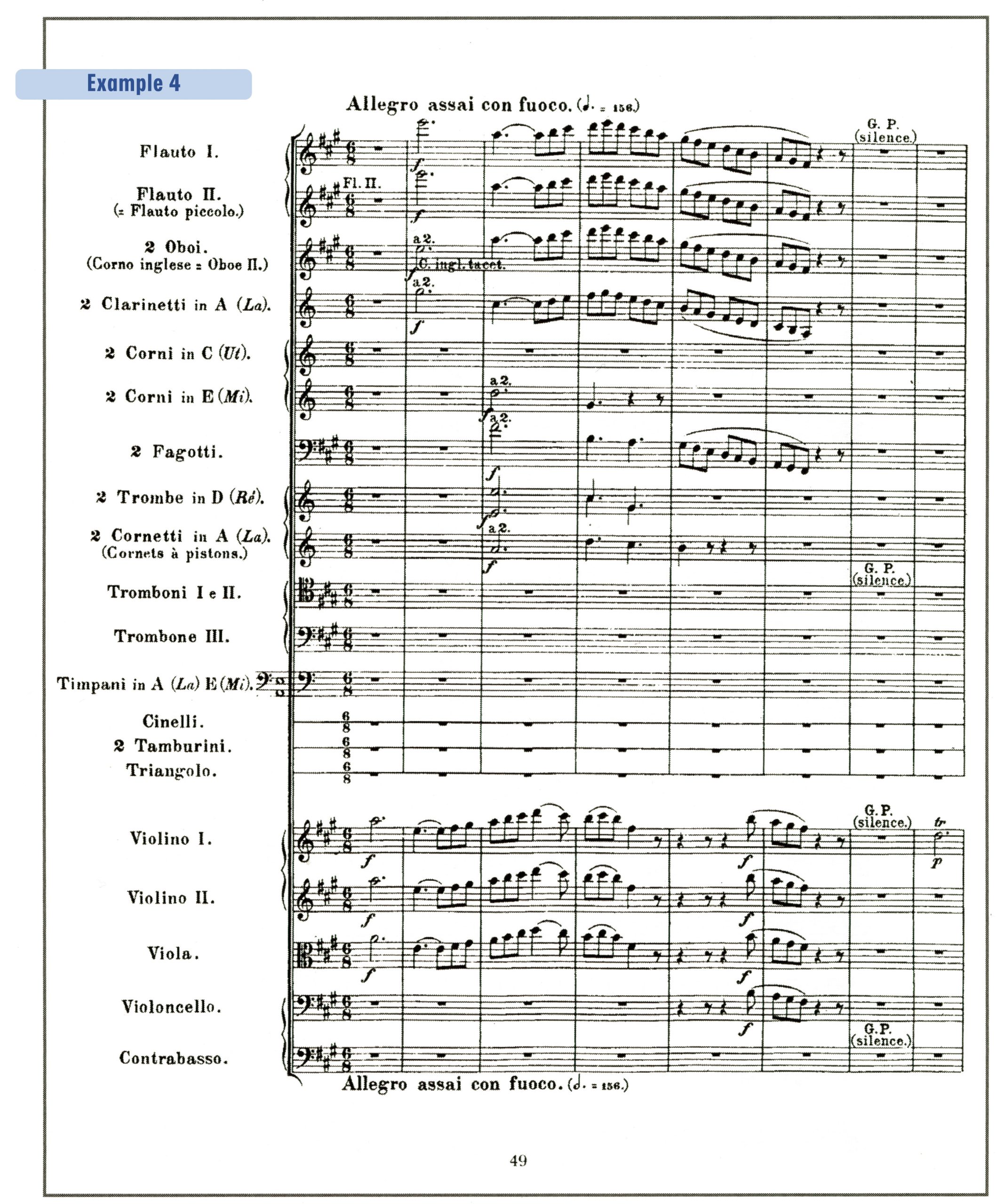
Example 4: Berlioz, Overture Carnaval Romain, first page of score with first trombone in tenor clef. (Breitkopf & Haertel, 1901, from Hector Berlioz Werke, Serie II, Band 5, 1900-1907, Plate H.B.10)
Thus Berlioz came to advocate three tenor trombones as the ideal trombone section:
“The best way of grouping the trombones in the theatre is, after all, the way that has been adopted in the Paris Opera, where three tenors are employed.”23
provided, of course, there was no loss of the high notes above B♭ on the first part—conveniently, one might say, since instruments were no longer provided by the Paris municipality and with players having to provide their own, the tenor trombone was the logical choice.
Regarding the third tenor, Berlioz was full of praise for the model designed by Adolphe Sax that was not necessarily larger than the other tenors but equipped with an F-valve:
“All orchestras should have at least one of these fine instruments.”24
Unfortunately, Berlioz did not amend his section on the trombone in his 1844 Traité (the manuscript of which, as mentioned above, he submitted a year before) to reflect his new perspective. This has therefore led to confusion today regarding his preferred instrument for the first and third trombone parts. Further confusion has been caused by the ambiguity of French part nomenclature. Jean-Georges Kastner wrote in 1836 of a problem that still exists today:
“Generally, the French composers have the use of only the tenor trombone which they write in three parts, but often continue to indicate them by the nominations Alto, Tenor and Bass, which gives rise to a singular confusion for foreigners.”25
It should be particularly noted that although Berlioz advocated a section of three tenors, he felt that to use the tenor trombone when an alto or bass had been intended by a composer was “to take unpermitted latitude in the interpretation of the composer’s wishes.”26
According to Hugh MacDonald, it appears that beginning with the 1835 version of Le Cinq Mai, Berlioz was designating the tenor trombone for the first part and “wrote his three trombone parts on tenor and bass staves and presumed that all the players would use tenor trombones.”27
Particular mention should be made of the first trombone part to the overtures Benvenuto Cellini (1838) and Le Carnaval Romain (1844), to which both of Berlioz’s autograph manuscripts have been lost. Whereas the first trombone part in the printed editions of both overtures appears in alto clef in publications such as those by Edwin Kalmus, the New Berlioz Edition, the authoritative historical-critical compendia of Berlioz’s compositions, as well as its predecessor, Hector Berlioz Werke, indicates that Berlioz scored the parts for tenor trombone. [see Note 28.]
In the first trombone part to the overture of Benvenuto Cellini, the highest note is an a’, which Berlioz, even in his earlier thinking, considered within the range of a tenor trombone. Moreover, near the middle of the Larghetto there is a low unison passage for the three trombones in eighth notes—A B c d—all notes that we recall Berlioz described as being of poor quality on the alto and thus should be avoided—and therefore a designation of alto clef, suggesting that Berlioz intended an alto trombone for the first trombone part, makes no sense whatsoever. In the first trombone part to the overture Le Carnaval Romain, the highest note called for is a b’ (Example 4), a supposedly high note which the reader will recall Berlioz previously thought reliable only on the alto. Thus the scoring for a tenor trombone would seem to confirm that Berlioz had re-assessed his opinion as to what was possible on the tenor trombone with regard to the upper register. (For further detail about the clef used in the published first trombone parts in both of these overtures see Note 28.)
The misleading printed first trombone parts demonstrate to us once again that publications—as is so often the case with works by Bruckner and Dvořák—are frequently unreliable indicators of a composer’s intention when it comes to designations of alto and tenor clef.²⁸ This cannot be stressed enough: too many players mistakenly determine whether a first trombone part is intended for an alto or tenor based solely on the printed part.
Summary
Regarding stylistic concerns, it is the aim of all conscientious trombone sections to be as faithful as possible to a composer’s intentions. Whereas any player familiar with Berlioz’s first trombone parts to Symphonie Fantastique, Les Francs-Juges, or Messe solennelle may demur at Howard Weiner’s description of parts written for the alto during this period as “largely [in] moderate ranges”,29 they are nonetheless within the capabilities of today’s principal trombone. As we have seen, for sure not all of Berlioz’s works that he originally considered playable only on the alto ascend as high as the three above-mentioned works. But b♭’ is no longer considered the uppermost reliable note on the tenor, nor are the notes b’–f” (or in Berlioz’s case b♭’–e♭”) the exclusive domain of a select elite few, and thus given Berlioz’s preference for the tenor (“assuredly the best of all, its tone is good throughout its entire range”) and dislike of the alto trombone’s sound (“small, shrill and of poor quality”), there is no historical justification for today’s first trombonist to perform his works on alto. Likewise, given Berlioz’s disaffection for the predominance of the bass trombone sound and stated preference for the part to be played by a tenor trombone, is it really appropriate to use any other instrument than a tenor trombone in a section of three?
More than many orchestral composers Berlioz gave thought and reflection to the best make-up of the trombone section. And of all the orchestral instruments Berlioz seemed to revere the sound of the trombone most of all:
“The sound of the trombone is so markedly characterised that it should never be heard but for the production of some special effect … In fact it possesses the utmost nobility and grandeur. [I]t has all the deep and powerful accents of high musical poetry, from the religious accent, calm and imposing, to the wild clamours of the orgy. It depends on the composer to make it by turn chant like a chorus of priests; threaten, lament, ring a funeral knell, raise a hymn of glory, break forth into frantic cries, or sound its dread flourish to awaken the dead or to doom the living But to constrain it … to howl out in a credo brutal phrases less worthy of a sacred edifice than of a tavern … [or] to mingle its Olympian voice with trumpery melody of a vaudeville duet … is to impoverish, to degrade a magnificent individuality; it is to make a hero into a slave and a buffoon; it is to tarnish the orchestra … ; it is to commit a voluntary act of vandalism, or to give token of an absence of sentiment for expression amounting to stupidity.”30
Therefore, if we wish to attain the correct Berlioz sound, instead of performing as a section of alto/tenor/bass—or even tenor/tenor/bass—we should be playing Symphonie Fantastique and his other symphonic works as a section of three tenor trombones.
Notes
-
-
“admettre en général une pareille latitude dans l’interprétation des volontés du compositeur [et] ouvrir la porte à toutes les infidélités, à tous les abus.” Hector Berlioz, Grand Traité d’Instrumentation et d’Orchestration modernes, Paris, 1844, p. 201.
-
“on doit regretter que le trombone alto soit, à cette heure, banni de tous nos orchestres parisiens.” Ibid., p. 199.
-
Hector Berlioz, Revue et Gazette Musicale de Paris, no. 10 (March 6, 1842), p. 92.
-
Berlioz, Grand Traité, p. 199.
-
Ibid.
-
“Le meilleur de tous, sans contredit. Il a une sonorité forte et pleine… et son timbre est bon dans toute son échelle.” (“Assuredly the best of all. It has a full and powerful sonority… and its tone is good throughout its entire range.”) Ibid., p. 200.
-
Ibid., p. 199.
-
““Les sons hauts, tels que Si, Ut, Ré, Mi, Fa, peuvent être fort utiles …” (“The upper pitches b’, c”, d”, e”, f” are highly useful.”) Ibid. As his contemporary Jean-Georges Kastner wrote in his Traité Général of 1836: “the alto trombone, which is in general usage in Germany, is hardly found at all in French orchestras, which is very unfortunate, because the tenor trombone which is forced to replace it is not capable of playing as high and the composer finds himself deprived of using the notes b’–f” of which he would have been able to take great advantage.” Jean-Georges Kastner, Traité Général d’Instrumentation, Paris, 1836; second edition, Paris, 1840, p. 41.
-
J. Rivière, My Musical Life and Recollections, London, 1893, p. 81. Dieppo was described by Berlioz as “un véritable virtuose” (Grand Traité, p. 224). Dieppo gives the dimensions of his trombone in his Méthode as a 10 mm bore (approximately ¼ inch) and a 12 cm bell (approximately 4½ inches). A. G. Dieppo, Méthode Complète pour le Trombone, Paris, c.1840, p. 2.
-
According to Hugh MacDonald, Berlioz submitted the manuscript in December 1842. Hugh MacDonald, personal correspondence, May 12, 1995.
-
“Observations réitérées, faites à Berlin, m’ont conduit à penser que la meilleure manière de grouper les trombones dans les théâtres est, après tout, celle qu’on a adoptée à l’Opéra de Paris, et qui consiste à employer ensemble trois trombones ténors. Le timbre du petit trombone (l’alto) est grêle, et ses notes hautes ne présentent que peu d’utilité. Je voterais donc aussi pour son exclusion dans les théâtres.” Hector Berlioz, Mémoires, vol. II, Paris, 1922, p. 97. Translation in E. Cairns (ed.), The Memoirs of Hector Berlioz, London, 1969, p. 320.
-
“Les trombones sont d’une belle force; le premier (M. Schrade) … a un véritable talent. Il possède à fond son instrument, se joue des plus grandes difficultés, tire du trombone-ténor un son magnifique.” Ibid., p. 24. Berlioz was also impressed by Schrade’s ability to play multiphonics. In a public concert Schrade produced a complete four-voice B♭7. Ibid. To be sure, Berlioz encountered his share of poor trombonists. In Mannheim he wrote that due to “l’insuffisance des trombones” he was unable to perform the finale of Harold: “Je dus supprimer le finale (l’Orgie) à cause des trombones manifestement incapables de remplir le rôle qui leur est confié dans ce morceau.” (“I had to cancel the finale (the Orgy) because the trombones were manifestly incapable of fulfilling the role entrusted to them in this piece.”)Elsewhere Berlioz described the Hechingen trombonist—there was only one—along with the timpanist and trumpeters as “knowing nothing” (“ils ne savent rien”). Mémoires, vol. II, p. 30. “The sole trombonist was left to his own devices; but by prudently giving him only notes with which he was very familiar such as B♭, C, F, and carefully avoiding all the others, he distinguished himself mostly by his silence.” (“Le seul tromboniste était livré à lui-même; mais ne donnant prudemment que les sons qui lui étaient très familiers, comme si bémol, ré, fa, et évitant avec soin tous les autres, il brillait presque partout par son silence.” Ibid., p. 31.) Of the Berlin trombonists he wrote, “Impossible! Totally impossible! It is enough to make you bang your head against the wall!” (“Impossible! Tout à fait impossible! . . . Et n’y a-t-il pas de quoi aller donner de la tête contre un mur?”) Ibid., p. 129.
-
Hugh MacDonald, personal correspondence, November 30, 1995.
-
Hugh MacDonald points out that the alto trombone part in this score is puzzling since it is notated in tenor clef, and asks: “was this defiance of convention a further cause of the Prix de Rome judges’ displeasure in 1829? Personal correspondence with the author, November 30, 1995.
-
“Le préjugé vulgaire appelle bruyants les grands orchestres; s’ils sont bien composés, bien exercés et bien dirigés, et s’ils exécutent de la vraie musique, c’est puissants qu’il faut dire; et, certes, rien n’est plus dissemblable que le sens de ces deux expressions.” Berlioz, Grand Traité, p. 297.
-
“la foule des compositeurs,” Ibid., p. 223.
-
“passions humaines,” Ibid., p. 205.
-
“d’en être complètement dépourvus,” Ibid., p. 200.
-
“la plupart,” Ibid.
-
Edward Solomon, personal correspondence with the author, January 27, 2015: “Berlioz did score for an E♭ Bass Trombone (an ad. lib. part on a tiny staff) in the Grande Symphonie Funèbre et Triomphale though he evidently did not actually expect it to be used with any degree of frequency. The part is quite pedestrian.” According to Hugh MacDonald: “Berlioz encountered the true bass trombone for the first time in 1837 when Johann Strauss the elder brought his Viennese orchestra to Paris. He observed that its low notes were ‘full, rich and powerful in effect’. He called for a true bass trombone only once, in the Symphonie funèbre et triomphale, where he calls it ‘grand trombone basse’. It is written in C although the E-flat instrument is implied. It is much exploited for low notes such as C and D-flat, and in keeping with his cautionary remarks he gives the part rests and gaps to allow for its greater demands on the player’s lungs. Berlioz marked it non obligé in the score and may never have had a player available to perform the part in Paris.” Hugh MacDonald, Berlioz’s Orchestration Treatise: A Translation and Commentary, Cambridge, 2002, p. 213.
-
“Il faut remarquer seulement que le son du Trombone Basse prédomine toujours plus ou moins, en pareil cas, sur les deux autres, surtout si le premier est un Trombone Alto.” Berlioz, Grand Traité, p. 215.
-
“Berlin est la seule des villes d’Allemagne (que j’ai visitées) où l’on trouve le grand trombone basse (en mi bémol). Nous n’en possédons point encore à Paris, les exécutants se refusant à la pratique d’un instrument qui leur fatigue la poitrine. Les poumons prussiens sont apparemment plus robustes que les nôtres. . . . Dans mes concerts . . . je fus obligé, remarquant qu’on l’entendait seul, de prier l’artiste qui le jouait de rester assis, de manière que le pavillon de l’instrument fût tourné contre le pupitre, qui lui servait en quelque sorte de sourdine, pendant que les trombones, ténor et alto, au contraire, jouaient debout, leur pavillon passant en conséquence par-dessus la planchette du pupitre. Alors, seulement, on put entendre les trois parties et avec trois ténors capables de lui résister.” Hector Berlioz, Memoires, p. 67; translation in Memoires of Hector Berlioz from 1803–1865, Annotated and the translation revised by Ernest Newman, Chatham, 1966, p. 308–309. Edward Solomon suggests that the “deep bass trombone in B♭” referred to the contra-bass trombone. Personal correspondence with the author, January 27, 2015.
-
“… la meilleure manière de grouper les trombones dans les théâtres, est, après tout, celle qu’on a adoptée à l’Opéra de Paris, et qui consiste à employer ensemble trois [trombones ténors].” Ibid.
-
“Tous les Orchestres devraient posséder au moins un de ces beaux instruments.” Berlioz, Grand Traité, p. 201.
-
“En général, les compositeurs français ne se servent que du Trombone-Ténor qu’ils écrivent à trois parties, mais qu’ils continuent souvent d’indiquer par les dénominations de: Alto, Ténor et Basse, ce qui, à l’étranger, donne lieu à de singuliers embarras.” Kastner, Traité Général d’Instrumentation, second edition, p. 41.
-
“admettre en général une pareille latitude dans l’interprétation des volontés du compositeur.” Berlioz, Grand Traité, p. 201.
-
Hugh MacDonald, personal correspondence with the author, December 19, 1995.
-
The manuscript for the overture of both works is unfortunately lost. However, in recent correspondence Hugh MacDonald writes to me that in his opinion: “Berlioz wrote his autograph full scores with the top trombone part on the tenor clef in both works. It’s clear to me that after 1835 or so Berlioz wrote all upper trombone parts on tenor clef and, in France, expected a tenor trombone to play them. We find the publisher twice printing the part on the alto clef, with or without Berlioz’s approval, and I presume that was done in order to assist the distribution in Germany where players still preferred alto clef and perhaps also played alto instruments.” (personal correspondence, 14–20 February 2015.) Vol. IA of the New Berlioz Edition prints two versions of the overture to Benvenuto Cellini; one called by MacDonald the “Paris 1” version, the other called the “Paris 2, Weimar” version. In both cases there are three trombones, in bass clef. On p. 121 of Vol. ID, which deals with the sources for Benvenuto Cellini, under “Sources of the overture”, MacDonald writes: “Since the autograph is lost, the principal sources for the overture are the full score and orchestral parts published by Maurice Schlesinger in 1839 and the Opera’s archival full score (Cl). These give the revised version (Paris 2, Weimar), while the orchestral parts of the complete opera (CO) are the single source for the original version (Paris 1).” New Berlioz Edition, Benvenuto Cellini, editor Hugh MacDonald (4 volumes; 3 of music, 1 of sources), Kassel, 1994–2005. In personal correspondence Hugh MacDonald writes: “In the 1839 Schlesinger full score of the Cellini Overture, the top trombone part is on the tenor clef, unlike the printed part which is on the alto clef. I presume from that that the players were thought to prefer alto clef still in 1839, and perhaps Schlesinger was thinking about German players. Throughout the opera manuscript of Cellini, Berlioz wrote this part on the tenor clef and is clearly for tenor trombone so I’m sure Berlioz did not intend otherwise in the overture; it can only have been the publisher that did that. Only the overture was printed at that time, but the overture is the bit of the manuscript that is missing. I agree with you, the low A confirms that it’s for tenor trombone.” With regard to Le Carnaval Romain, in the New Berlioz Edition of collected works the first trombone part of the overture is in tenor clef. The note on the sources that the New Berlioz Edition has used for its edition (NBE, Vol. 20, pp. 302–303) states on p. 302: “The whereabouts of the autograph score being unknown, this edition is based on the 1844 printed score and on two editions of the orchestral parts, one from Paris, one from Berlin, which seem to have been derived from manuscript orchestral parts now lost.” The orchestral parts used are those published in Paris by Schlesinger, undated but assumed to be 1844, and those published in Berlin by the same publisher, dated here to 1844–45, pl. no. S. 3039.” Romain Carnaval, editor Diana Bickley, 2000. In the Hector Berlioz Werke (Serie II, Band 5, editors Charles Malherbe and Felix Weingartner, Breitkopf & Härtel, Leipzig, 1901–1907) the first trombone in the score appears in tenor clef. For reasons upon which one can only speculate, the first trombone part published by the same company appears in alto clef, with an alternate part in bass clef. “Surely Berlioz’s missing manuscript was not written that way,” continues MacDonald. “It must have been someone at Breitkopf who felt that alto was correct in the parts when printing this overture. After all, they changed quite a lot of other things. … Edwin Kalmus reprinted his scores from Breitkopf with no intermediate editing.” With regard to determining the correct species of first trombone for the works of other composers such as Bruckner, Brahms and Dvořák, see Chapters 2–5 in Ken Shifrin, Orchestral Trombone Practice in the Nineteenth Century with Special Reference to the Alto Trombone, PhD dissertation, Oxford University, 1999.
-
Howard Weiner, “When is an Alto Trombone an Alto Trombone? When is a Bass Trombone a Bass Trombone?”, Historic Brass Society Journal 17 (2005), p. 54.
-
“Le son du Trombone est tellement caractérisé, qu’il ne doit jamais être entendu que pour produire un effet spécial … [I]l possède en effet au suprême degré la noblesse et la grandeur; il a tous les accents graves ou forts de la haute poésie musicale, depuis l’accent religieux, imposant et calme, jusqu’aux clameurs forcenées de l’orgie. Il dépend du compositeur de le faire tour à tour chanter comme un chœur de prêtres, menacer, gémir, sourdement murmurer un glas funèbre, entonner un hymne de gloire, éclater en horribles cris, ou sonner sa redoutable fanfare pour le réveil des morts ou la mort des vivants … Mais le contraindre … à hurler dans un credo des phrases brutales moins dignes du temple saint que de la taverne … [ou] à mêler sa voix olympienne à la mesquine mélodie d’un vaudeville … c’est dégrader une individualité magnifique; c’est faire d’un héros un esclave et un bouffon; c’est décolorer l’orchestre; … c’est volontairement faire acte de vandalisme, ou prouver une absence de sentiment de l’expression qui approche de la stupidité.” Berlioz, Grand Traité, pp. 205, 223; trans. Clarke, pp. 156, 173; edited by A. C. Howie.
-
Ken Shifrin Online