
Did Wagenseil Write the “Wagenseil Concerto”?
by Ken Shifrin
Originally appeared in the International Trombone Journal, July 2020, Volume 48, Number 3
Housed in the Archives of Castle Kroměříž in the Czech Republic—one of Europe’s most significant and valuable repositories of baroque music—are the apparently only existing manuscript parts to the exquisite concerto for trombone by the Viennese composer Georg Christoph Wagenseil (1715–1777). However, an examination of these parts viewed in historical context raises some interesting questions. Specifically, is it a concerto? And did Wagenseil compose it?
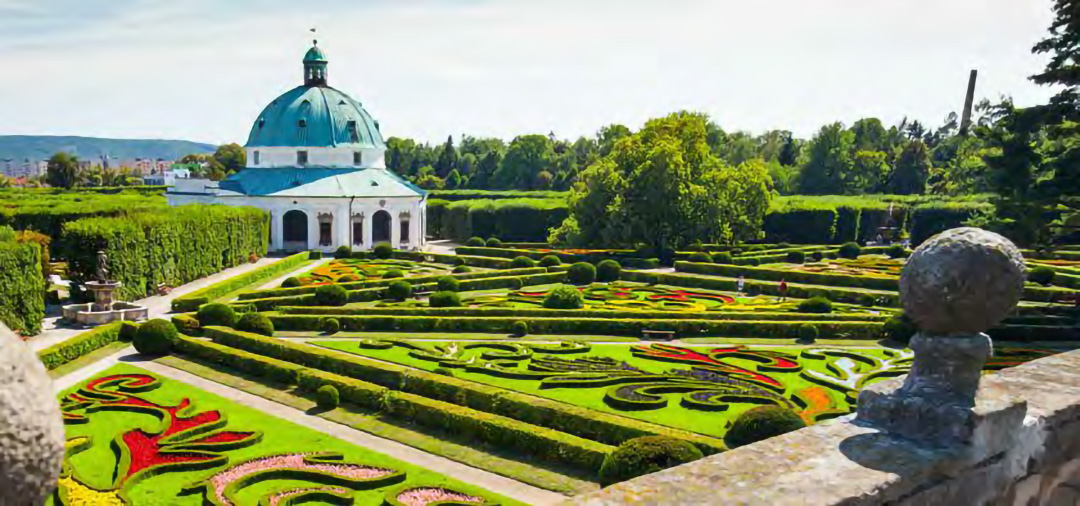
Gardens at Castle Kroměříž, Kroměříž, Moravia (Czech Republic)
The solo and orchestral parts to the concerto (KROM IV A 32) exist in two sets (Examples 1 and 2). There is no score and the parts are copied by different hands. Moreover, the autograph has never been found. The esteemed Bohemian baroque music expert Dr Jiři Sehnal of the Brno University speculates that the Kroměříž parts were written around 1780, but is unable to deduce from the calligraphy and watermarks which of the two sets is older or whether the parts were copied by Viennese or Bohemian scribes.1 Interestingly, only one of the Kroměříž sets is entitled “Concerto.” The only obvious discrepancies that I could discern between the two sets, aside from the inadvertent treble clef rather than alto clef sign in the solo part of one set, is that in the accompaniment of the “concerto set” the words “cresc,” “crescendo,” and “tenuto” (rather than the symbols) are occasionally found in the Flute and Violin 2 parts. These superficial indications of a perhaps more modern style of notation, intriguing as they are, however, are hardly conclusive. In neither set is there a tempo indication for the first movement. The editor, Kurt Janetzky (Willy Mueller, Süddeutscher Verlag) in the first publication of this work in 1963, uses the safe, non-controversial “con discretione (quasi andante),” Bryan (Universal 1979) and Angerer (Reift 1990) both suggest “Adagio” whereas Sauer (Cherry 2000) uses “Andante.”
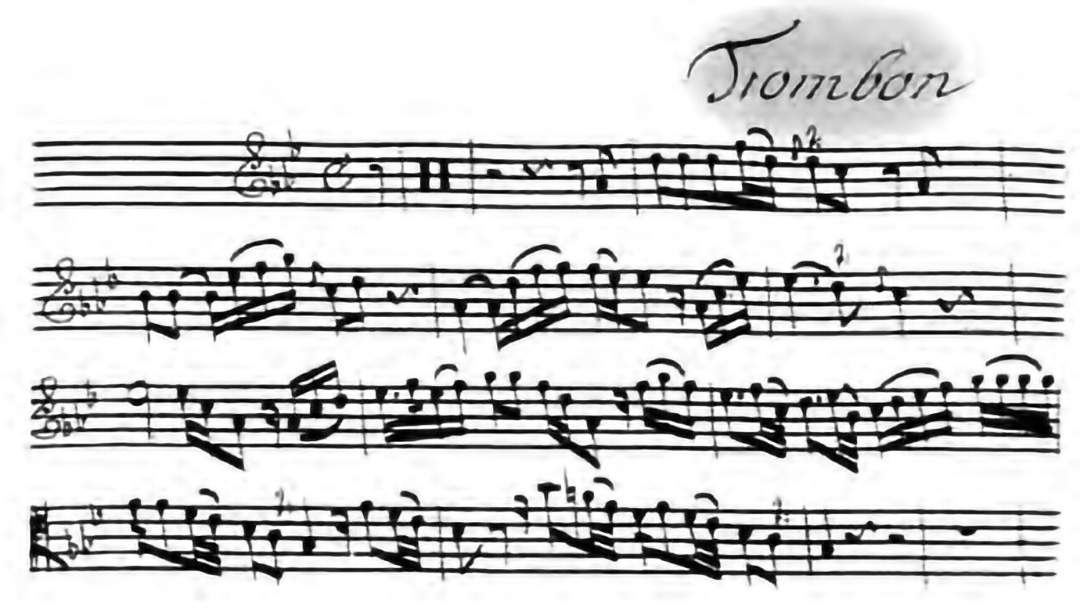
Example 1: Beginning of “Wagenseil Concerto” Set 1 [KROM 1V A32, Kroměříž Archives
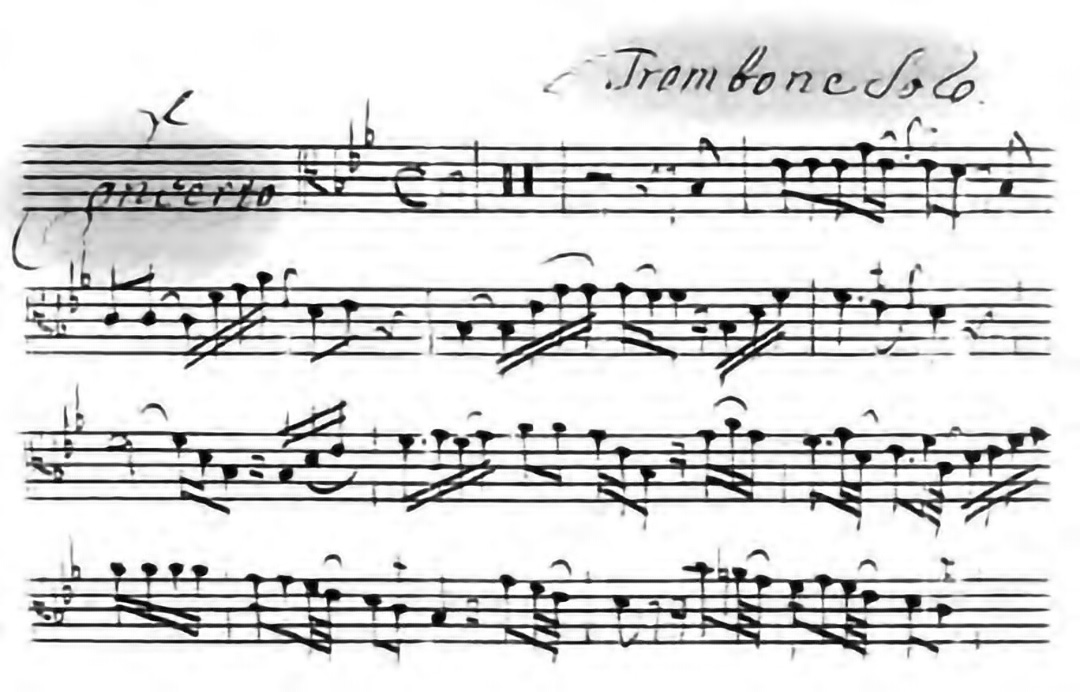
Example 2: Beginning of “Wagenseil Concerto” Set 2 [KROM 1V A32, Kroměříž Archives]
Generally, the Wagenseil is considered by most trombonists to be the earliest written concerto for our instrument. But is it? Are we certain that this work pre-dates the 1769 Albrechtsberger Concerto for Alto Trombone? According to Bohumir Dlabač’s 1815 Allgemeines Historisches Künstler-Lexikon, the Czech trombonist František Medikus whose death in 1757 pre-dated both the Albrechtsberger and Wagenseil concertos, performed all the most difficult trombone “Solos und Konzerte”2; and the renowned Prague trombone-playing priest, Gotthard Stolle (1739–1814) is said to have composed twelve concertos, as well as several solos and arias for the trombone.3 Furthermore, in the Kroměříž Archives one finds a catalogue from the library of the 18th century Archbishop Egk, that includes the incipits from three anonymous trombone concertos written about 1750, now lost. The oldest existing solo composition written specifically for trombone,4 the “St Thomas Sonata for Trombone” (Virgo Music Publishers), an anonymous four-movement sonata uncovered in the archives of the Saint Thomas Church of Brno in Moravia (Czech Republic), was composed about a century earlier than the Wagenseil.
The fact that the Wagenseil solo work consists of only two movements raises some important questions. Could there be a missing movement, and if so, the same one from both sets? The accepted format of concertos during this period was three movements (fast/slow and lyrical/fast), and included amongst the Einzelwerken [Individual Works] in the Wagenseil thematic catalogue compiled by Scholz-Michelitsch are 103 other concertos, all of them in three movements,5 with the last movement typically a menuetto. Why trombonists have so rarely questioned this anomaly is rather puzzling. Could it be that we trombonists, so bereft of original, solo baroque repertoire (and I use the term “baroque” somewhat loosely), feel we cannot be too picky about terminology?
More likely than the same movement missing from both sets—and bear in mind that only one of the two sets is entitled “Concerto”—is that this two-movement solo work for trombone and orchestra was not a concerto, but part of a multi-movement Serenade.
The Gschladt Connection:
A Concerto or Serenade?
It is an intriguing coincidence that the “greatest living trombonist in Christendom,” Thomas Gschladt (1723–1806) whom Leopold Mozart praised as a “great master on his instrument on which few others are equal,”6 (and was proficient on the violin, ’cello, and horn as well) after gaining his release from the Archbishop of Salzburg where he was employed for thirteen years, moved to Olomouc in 1769 for a better paying job (and presumably to free himself from butler/valet duties which were the customary responsibilities of the court musician when not playing) to take up the position of Stadt Turmmeister [Director of City Music], remaining there until his death at the age of eightythree. Serenades and Divertimenti (multi-movement musical compositions featuring soloists of the ensemble) written in Salzburg, including Michael Haydn’s Sinfonia (incomplete), Serenata, and Divertimento in D, as well as Leopold Mozart’s Serenata (the latter has three solo trombone movements which is commonly and incorrectly referred to as a concert7) most assuredly featured Gschladt as the trombone soloist. Such works were very much in vogue in the courts of the nobility throughout the Austrian Empire, and the Court of the Bishop of Olomouc was no exception. Olomouc, then the capital of Moravia and one of the most important bishoprics of the Austrian Empire, was located less than thirty miles away from the official residence of the bishops in Kroměříz Castle. Shortly after his taking up his new post as Turmmeister, Gschladt was involved in a dispute with Anton Neumann, Kapellmeister of Olomouc Cathedral, St Wenceslaus, about the quality of the musicians Gschladt provided the Kapellmeister. Gschladt argued he required more money to train the musicians properly, but Neumann was able to convince the church officials to pay him (Neumann) an extra supplement (less than what Gschladt had demanded) to train the musicians himself, thus saving themselves money in the bargain.8 Gschladt was so insulted that he vowed never to play again in Olomouc Cathedral after July 1, 1770.9
However, on Thursday October 9, 1777, for the occasion of the election of the new Archbishop of Olomouc, Coloredo- Waldsee, not only was Gschladt induced to play at the Cathedral, but according to a receipt signed by Gschladt unearthed from the Olomouc City Archives, he was engaged “to perform music composed especially for the Ball for His Highness the Prince-Archbishop, esteemed graces and the gentlemen of the chamberlain”10 held in the Archbishop’s honour that evening, for which he received the sum of sixteen Gülden. (Figure 1). This is approximately $400–$500 today in US Dollars, but in Austrian Empire at the time, it was more like $3,000–$3,500. Not a bad gig—not to mention the fact that the 54-year-old Gschladt was apparently able to get his chops back in shape after a supposed seven-year layoff! More to the point, such a fee for one performance lends support to the idea that Gschladt was engaged to perform something new and very special that evening.
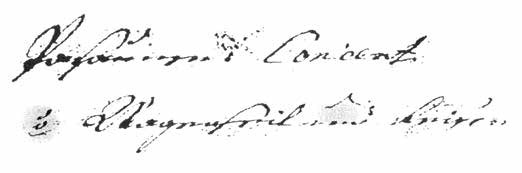
Figure 1: Cover of the two sets of “Wagenseil Concerto” Parts: “Trombone Concerto by Wagenseil and Reiter” [KROM 1V A32, Kroměříž Archives]. “Posaunen Concert, [v]o[n] Wagenseil und Reiter” [“Trombone Concerto, by Wagenseil and Reiter.”] The “v” in “von” appears to have vanished over time, while the abbreviated “n” is indicated by the stylised contraction mark over the “o.”
Serenades were customarily performed in the evening in honour of a distinguished personage. Moreover, Olomouc at this time was one of the seats of the highest nobility in the Austrian Hapsburg Empire (the honorific “Prince” was appended to the title of the bishops). The Musikkapelle of the Court of the Bishop of Olomouc was one of the foremost orchestras in the Hapsburg Empire, apparently rivalling even that of Vienna. Seen in this context, is it so unlikely that the music “composed especially for the Ball” would have been a Serenata by the distinguished Georg Christoph Wagenseil, a well-known figure in his day and a popular composer at the Olomouc Court, which was performed that evening for the first time on this most important occasion to honour the newly elected Prince-Archbishop? As Professor Paul Bryan points out in the Foreword to his edition by Universal, there is no evidence that “the Wagenseil” was ever intended for a Viennese performance. Keeping in mind Professor’s Sehnal’s informed belief that the parts were copied out around 1780, I contend that the evidence points to a new Serenade being performed that evening which would have included two solo movements for trombone that were premiered by the Olomouc trombone virtuoso Thomas Gschladt—the other movements having been lost or misplaced.
Who wrote the “Wagenseil Concerto”?
What would Groucho say?
In typing the above-sentence I am reminded of the old Groucho Marx joke “Who’s buried in Grant’s tomb?” And just as the correct answer actually included two people (President Grant and Mrs. Grant), the answer to our Wagenseil musical version of Groucho’s question seems to involve two composers. On the cover of the Kroměříž parts, written in a third 18th century hand is the barely decipherable inscription which, according to the late Professor Brian Trowell of the Oxford University Music Department to whom I am most grateful for his expert assistance, reads: “Posaunen Concert, [v]o[n] Wagenseil und Reiter” [“Trombone Concerto, by Wagenseil and Reiter”]. The “v” in “von” appears to have vanished over time, while the abbreviated “n” is indicated by the stylised contraction mark over the “o”. (Figure 2). Wagenseil expert Scholz-Michelitsch also contends that “als Autoren dieses Ms. Werden ‘Wagenseil and Reiter’ angeben.” [“ ‘Wagenseil’ and ‘Reiter’ are given as the names of the composers of this manuscript.”]11 In the catalogues of the Kroměříž Music Archives, a listing for “Reiter = Reutter” is found. Johann Adam Joseph Karl Georg Reutter (1708–1772), whose name was often written by copyists as Reuter/Reuttern/Reiter/Reitern and other variations, was the Kapellmeister not only of the Austrian Imperial Court but Vienna’s St Stephen’s Cathedral as well, and according to musicologist David Wyn Jones in his The Life of Haydn (Oxford University Press), in his heyday was the most influential musician in Vienna. Moreover, Reutter is well represented throughout Czech musical archives.
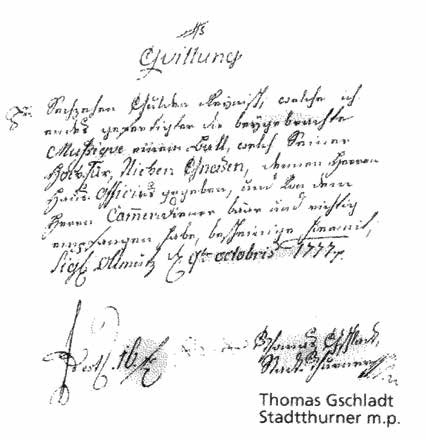
Figure 2: Thomas Gshladt’s receipt, October 9, 1777: “I hereby confirm receipt of 16 guilders, which I have received to perform music especially composed for the Ball for His Highness the Prince-Archbishop, esteemed graces and the gentlemen of the chamberlain. Certified on Thursday, October 9, 1777. Thomas Gschladt, City Director of Music.” I am indebted to Thomas Rink, esteemed German baroque bassoonist, and Doreen Lutomski, Transcripteur, for the invaluable expertise in assisting me to decipher the Kurrent (old German handwriting).
Both Reutter and Wagenseil were contemporaries in Vienna. Wagenseil, a Court composer during the years 1739 until his death in 1777, and a well-respected musical figure, has nevertheless always struck me as a somewhat unlikely composer to have written a concerto or solo work for trombone. Even with a plethora of the leading trombonists in Europe at his disposal at the Vienna Court, including Andreas Boog, Ignaz Steinbrucker, Stephan Tepser, Ferdinand Christian, Wenzel Thomas, Ignatz Ulbrich, and the most renowned of the group, Leopold Christian [Der Jüngere = the Younger], he seemed to write for them rarely. Indeed, the only noteworthy compositions with which I am familiar in which Wagenseil employed the trombone as a solo instrument is the rather pedestrian obbligato part of “Memorium” from his sacred work Confitebor,12 and two trombones in mundane obbligato roles in his Missa solenne Immaculatae Conceptionis and an undistinguished six-bar introduction in canonic imitation after the “Sancta Mater” in his Stabat Mater. Reutter, on the other hand, employed the trombone as an important obbligato soloist in his liturgical works on numerous occasions and far more imaginatively and floridly than Wagenseil, for example in the “Speculum” from his Lytania Lauretano, and both the “Gloria” from Missa S. Caroli and the “Tuba Mirum” from his Requiem, which demand virtuosic technical skills, flexibility, and endurance to perform long trill sequences. Of the two composers, the “Wagenseil Concerto” is clearly more reflective of Reutter’s style of writing for trombones than Wagenseil’s.
Although it is not known if Reutter composed any serenades or divertimenti, his compositional output was by no means limited to strictly sacred music. In addition to wind partitas (sometimes referred to as multi-movement dance suites), it is noteworthy that Reutter wrote two solo works for trumpet, whereas Wagenseil composed no solo works for brass other than the piece that is the subject of this article. Could the “Wagenseil Concerto” have been an unfinished solo work for trombone composed by Reutter that Wagenseil completed, Reutter’s death pre-dating Wagenseil’s by five years? Could an enfeebled, sciatica-stricken Wagenseil, nearing the end of his life, taken a “short-cut” by using material sketched out by Reutter?
As the solo part is so well-scored and idiomatic for the trombone13 I am very sceptical that a Reutter sketch—if that is indeed what it was—could have been intended for any instrument other than trombone. Indeed, many of the hallmarks of Reutter’s writing for solo-obbligato trombone in his religious works are mirrored in these two solo movements for trombone.
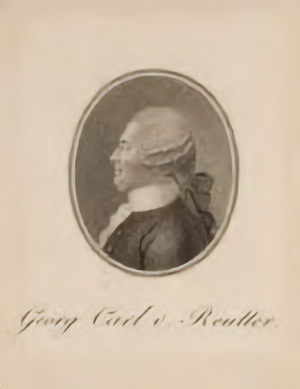
Johann Adam Joseph Karl Georg Reutter (1708–1772).
Source New York Public Library Digital Collections.
Image ID 1575471
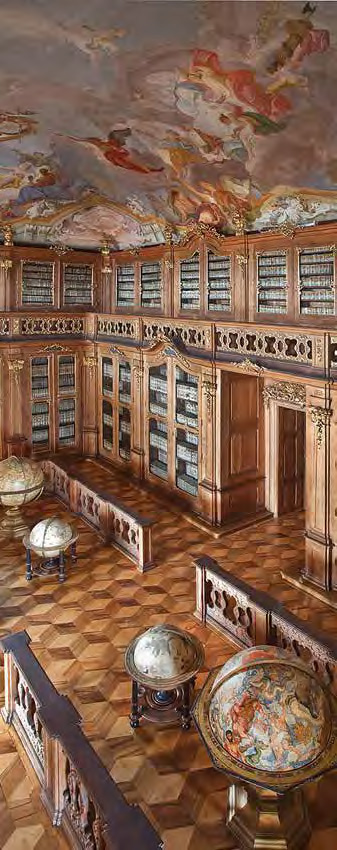
Castle Kroměříž Archives, Kroměříž, Moravia (Czech Republic).
Professor David Wynn Jones writes:
I think the central contention of your article is a persuasive one, that the work is more likely to be by Reutter than Wagenseil. The whole background of concertante writing for trombone (also organ) in Vienna up to ca.1780 is more common in sacred music, from Fux to Tuma, the two Reutters and, of course, informs the Mozart Requiem. Reutter
lived and breathed church music. . . . Remember that liturgical services at the time often featured a mixture of composers for the mass itself, offertory, instrumental and gradual (as many as three or more), and the mixed attribution may have been a consequence of that widespread practice, never mind contemporary librarians mis-shelving items.14 Notwithstanding that these two solotrombone movements in the author’s opinion most probably were part of a multi-movement Serenade, does the fact that an 18th century archivist referred to the trombone movements as a Concerto on the cover as well as one of the copyists of the solo part, suggest that a third movement has gone missing?
Professor Jones continues:
I wouldn’t be too bothered that it’s in two movements: if it was originally [intended by Reutter] as part of a liturgical service . . . it could be called sonata, concerto, even sinfonia.15
Further complicating matters in determining the respective roles Reutter and Wagenseil played in the composition of these two movements for solo trombone is the fact that Wagenseil died on March 1, 1777, six months before the celebration in honour of the election of the new Archbishop of Olomouc. Could Kapellmeister Jakob Vegini have played any role in putting the finishing touches on the work?
Other sets of parts of this work from Vienna and Breslau [today Wroclaw, Poland] which the deceased editor of the first publication of the “Wagenseil Concerto”, Kurt Janetzky, states in his Vorwort that he consulted in the preparation of his edition, could very possibly shed light on the specific contributions Wagenseil and Reutter made in the creation of this lovely work for trombone. However, despite countless efforts by distinguished researchers, no trace of parts have been located, nor reference to any having formerly been held, in any of the repositories in Vienna; according to Dr Kenneth Hanlon there is no listing for a Viennese copy of it in RISM (Répertoire International des Sources Musicales), the international organisation that documents the extant historical sources of music from all over the world. With regard to Janetzky’s claim to have studied a set of parts in Breslau, there is no record of any such work being held in any of the city repositories, wrote Marek Romanczuk of the Wroclaw University Music Library to the author of this article,16 nor in the Berlin Staatsbibliothek, according to Head Librarian Ute Nawroth17 where numerous Breslau manuscripts are still housed, having been moved for “safekeeping” during World War II.
Since 1963 there have been at least five publications of this two-movement solo work for alto trombone and orchestra, in addition to arrangements with piano accompaniment, organ accompaniment, band accompaniment, wind ensemble accompaniment, CD accompaniment, a version in Bb for tenor trombone, an arrangement for trombone quartet, an arrangement for trombone quintet, a brass quintet—indeed there seems to be such a plethora of different arrangements I wouldn’t be surprised if someone turned up a duet for trombone and kazoo—as well as recordings too numerous to count. To my knowledge, not a single publication or recording in the last nearly sixty years acknowledges Reutter, and all attribute the concerto solely to the pen of Wagenseil.
Whether two-thirds of a concerto or two movements from a serenade, of one thing we can be certain: It is incorrect to refer to Wagenseil as the composer of this very beautiful staple of the trombone repertoire. We should not be referring to it as “the Wagenseil,” but as “the Wagenseil/Reutter.” Better still: “the Reutter/Wagenseil.” Hopefully we will do so in the future.
Notes
-
Personal correspondence with the author, September 24, 1998.
-
Bohumir Dlabacˇ. Allgemeines historisches Künstler- Lexikon für Böhmen und zum theil auch für Mähren und Schlesian, Vol. J–R, 1815, Prague, col. 293.
-
Ibid, Vol. S–Z, col. 25.
-
The thirty-nine bar La Hieronyma by Giovanni Martino Cesare published in 1621 was composed for either trombone o viola.
-
Helga Scholz-Michelitsch, Das Orchester-Und-Kammermusikwerk von Georg Christoph Wagenseil, Thematischer Katalog, Wien 1972, p. 92.
-
“Ein grosser Meister auf seinem Instrument, dem es sehr wenig gleich thun werden.” Charles H. Sherman, ed., Michael Haydn, Larghetto, Perger nr. 34, Summer 1973, Vorwort.
-
The nine-movement Serenata, ca.1756, was discovered by Dr Alexander Weinmann in 1973 in the Archives of Seitenstetten Abbey in Lower Austria.
-
Jiří Sehnal, “Hudbu v Olomouce Kathedrale v 17 a 18 Stoleti,” MZM, Brno, 1988. p. 47.
-
Ibid., pp. 82–83.
-
State Archive Olomouc, Quittung [receipt], July 10, 1777.
-
Scholz-Michelitsch, op.cit., p. 92.
-
Wagenseil’s contemporary, Johann Georg Albrechtsberger (1736–1809) on the other hand, exploited the trombone’s beauty in sacred works, such as the trombone solo-obbligati in “Gaude Virgo” from Ave Regina and “Aria de Passione Domini” which are reflected in a similar style in his concerto, particularly the 2nd movement.
-
Especially for the trombonists of the time: note the number of times the composer, rather than having a melodic sequence ascend as one would expect, “drops the octave” in order to avoid what was then considered fatiguing and a risky upper tessitura.
-
Personal correspondence with the author January 8, 2020.
-
Ibid.
-
Personal correspondence with the author, January 16, 2001.
-
Personal correspondence with the author, February 11, 2001.
Ken Shifrin Online